Wednesday, October 7, 2009

Moral Panic ( 7/10/09 Lesson)

Stretch & Challenge Unit
Moral Panic:
  • Abstract concept used to make sense of 'irrational public hysteria'
  • Public & academic debate on moral panic works on the assumption that the media plays a significant role in determing the characterics of moral panic
  • Signifies complex processes that shape public perspections of a perceived threat to the moral code of society

Processual Model

  • Attends to process of a moral panic
  • 7 defined stages ( Stanley Cohen "Folk Devils & Moral Panic 1973)
  • Emergence: When a form of behaviour becomes perceived as a threat
  • Media Inventory: explaination of threat is manipulated by media ( distortion, exaggeration)
  • Moral entrepreneurs: groups pr organisation speak out & offer solution
  • Experts: Socially accrediated experts ( government, police) who diagnose solution
  • Coping & resolution: reaction of the media, moral entrepreneur & experts lead to legal reform
  • Fading away: the condition disappears, submerges or deteriotes & become more visible
  • Legacy: a moral panic can have long lasting effect or create big changes in social policy, the law or society's view itself

Attributionsl Model: Erich Goode & Nachman

  • Ben Yehuda's study 'Moral Panics: The social construction of deviance (1994)
  • Claims those working in the media, political institutions & the legal system. Impact on moral panics through 'claims making'
  • 5 elements or criteria distinguish attributes of moral panic
  • Concern: a heightened level of concern, measurable through opinion, polls etc
  • Hostility:Increased hostility to a group or category seen as 'enemy' to respectable soceity (folk devil)
  • Consensus: a substantial segment of society agrees that the threat is real & caused by 'wrongdoers'
  • Disproportionality: the reaction by the public is out of proportion to the actual harm
  • Volatility: the idea that moral panics are volatile by nature, erupt quickly but also often subside quietly. Each episode cannot be sustained for long

Political Britain & the media (30/09/09 lesson)

Ideologies-(1789)
  • French Revolution- Enligment
  • French revolution got rid of the royal family & aristocracy was killed. this was done to bring equality, liberty & fraternity ( brotherhood)

Enlightment- light of knowledge- freedom of thought. This fed into Britain in terms of ideology. Enlightment in Britain brought in the subjcet of Scientific Rationalism Vs Religional belief. Scientific Rationalism were about scientific reasons behind everthing. Erasmus Darwin- Grandon of Charles wrote 'Orgin of Species' which was the theory of evolution. Whereas religional belief was arejection of religion (atheism).

Ideologies- Karl Marx

  • He developed Marxism which is the ownership of capital or means of production
  • He argued that those who own the means of production control the society.
  • This creates superstructure- has all the power & miney
  • Base- no power & money

Ideologies- Whigs (Liberal) & Tories ( British Government in Victorian era)

  • These people were mainly land owners, factory owners or members of the aristocracy
  • By the end of the 19th century, there were three government
  • Liberal- who were influenced by economists such as Adam Smith- Free economy/marker (no regulation)
  • Conservaties- believed in pragmatism ( protection of old values)
  • Labour- Supports rights for the working class. they want the state to control more & bring equality.

16/09/09 lesson on Media Case study

Collective Identity is a social gropu that is constructed or that we form.
Britishness- What er sre born into/migrate into
Social grouping: eg Chav, emo,memo,skaters

Transpotting
  • Representation of working class Glaswegion- ethnicity/class
  • Heroine users
  • Individual images within this
  • Funded by C49institution) values
  • This film higlights social issues, mediates (glamouries)
  • Social problems- Heroine addictions HIV/AIDS
  • Mediates (puts sirector's spin on)
  • Disenfranchised(powerless)- no money

Recent Films- What version of Britishness is being represented?

'This is England'

  • Collective Identity of the past (1980s)- political era
  • Northern Working class men
  • 'Skin Heads'
  • White supremises

Bridget Jones

  • Representation of middle class women ( set around mid 30s)
  • Popular with female audience aged 25 & over
  • Explores issues within women 'being single', 'overweight'
  • Easy to relate

Kidulthood

  • Working class representation of young people from London
  • Negative & exaggerate view of young people
  • Very Socially aware- Observant of class & ethnicity within young people

Tuesday, October 6, 2009

Identify how Sense an Sensibility and Four Weddings and a Funeral represent aspects of Bristish society past and present.

Sense & sensibility both represent British society. The main difference between these films is the timeline. Sense an sensibility is a historic film which was first publisged as a novel by Jane Austen in 1811 whereas Four Weddings & a funeral is a postmodernist film about marriage which was released in the year 1994. One of the main difference in this film is the timeline as Sense & sensibility was set around the 19th century whereas four weddings & a funeral was set in the 90s. Both have similarities such as the same actor(Hugh Grant), both represent the middle class but in four weddings & a funeral we see a different representation of the middle class as the society changed.

In sense & sensibility we see a very patriarchal society where men are the dominant figure. after the death of Marianne Dashwood's father all the wealth is inherited bu the next male decedent by the law. this clearly shows the gender difference where women are in a disadvantage. whereas in four weddings & a funeral we see a change in tradition in terms of class & gender roles. The meaning of middle class are different in both films. In sense & sensibility we see middle class people as being very rich land owners who have servants & maids. On the other hand, in Four weddings & a Funereal we see a completely different representation. Middle class people tend to have jobs such as lawyer, doctors etc. In sense & sensibility marriage is taken very seriously, this is the opportunity for women to leave their home, a sense of freedom.whereas in Four weddings & a funeral we see a very post modernist view of marriage. marriage is not taken seriously & seen as valueless.These two films clearly show a transition in the way how British society has changed.


Sunday, September 20, 2009

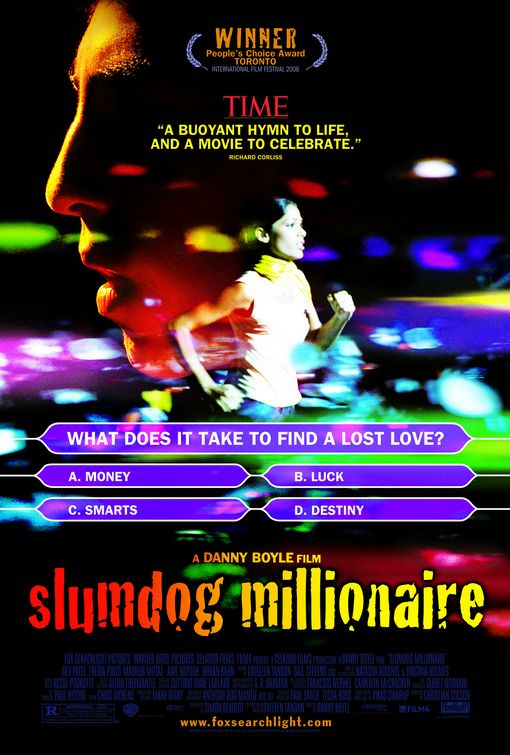
Comparison of Slumdog Millionarie & Somers town

Slumdog Millionaire
Cast:
Dev Patel: Jamal K MaliK

Fredia Pinto: Latika

This film is directed by Danny Boyle & Loveleen Tandan( co-director:India). Slumdog millionaire is a film about an Indian boy who grew up in the slums & becomes a contestant on the Indian Version of "Who wants to be a millionaire?" . He is arrested in suspicion of cheating while being interrogated. Events from his life history are shown which explains how he knows all the answers. Therefore, slumdog millionaire is not entirely seen as a British film as it set & filmed in India . Also, the film was an adaptation of a novel written by Vikas Swarup. Slumdog millionaire was distributed by Pathe Pictures international, Fox searched light pictures who teamed up with Warner Bros.

Somers Town
Somers town was distributed by 'Film Movement' & directed by Shane Meadows. This film was funded by EuroStar. This film is about 2 boys, both newcomers in London, forge an unlikely friendship over the course of summer. The boys are both infatuated with the same girl & pass their day bickering over which one of them she loves the most. A black & white study of a social environment in London.

Wednesday, September 16, 2009

New blog

I have created a new blog for our practical project for examiners & teachers to see how we have developed as a group. So, my new blog will have all my practical work & i'll use this blog to post my work that i have done at class or for homework.

Tuesday, September 15, 2009

Representing Contemoprary Britain

This article considers the ways in which British Cinema has represented the perspectives& experiences of those dwelling in contemporary Britain. This article has detailed information on sexuality, class, men, women & ethnicity.

Sexuality: Although sexual desires is a persistent theme in british cinema, it is usually dealt in a manner that is 'over flippant'.Whereas, other films that push the boundry of sexual frankness such as The Principles of Lust(2003) sexual desire is potrayed as fundamentally self- destructive or seen as wrong.

Class: A poll carried put by the Guardian newspaper in 2007 shows that 'ten years of Labour rule has apparently failed to create a classless society'. Films such as Atonement are constructed upon problematic relationahips between characters postioned differently on the social scale. Notingham Hill also positions its middle class characters with in an area of the capital economy commonly associate with ethnic & social diversity.

Men: British films are still dominated by narrative of male experience. but there has been non-masculine 'performance' as part of the stragery of improvement. Films such as The Full Monty, Billy Elliot show the impact of these types of films in society. Films such as Goodbye Charlie Bright(2001), The Football Factory & the buissness have proven to be more capable for giving the message about the contemporary pressure upon working class men than the films of other 'respectable' socially commited directors. In family films such as Harry Potter series, Strombreaker(2006) etc, young actors act as young heroes targetting audience in saving the world.

Women: Male dominated films far outnumber those told from the female perspective. Historic films such as Elizabeth & Charlotte Gray have been praised & celebrated for the role played by women.Recurring Scenarios of men dominated films have occassionally been answerd by 'female equivalents'. E.g the narrative of collective male endeavour is echoed by stories of self-empowerment in school for seduction, calender girls etc.Whereas, Beautiful creatures(2000)& High heels& low lives(2001) offer a glossily femanist spin on the buddy' movie, the ganster film & the caper movie. There has been an increse in the no of female directors entering the british film industry who could possible change the face of British films.

Ethnicity: British films have failed to represent all ethnic minorities. Its only after year 2000 that british films have focused on other ethnic minorities. in recent years,British Asian narrative films, characters have been most successful in british cinema such as Bend It Like Beckham, East is East etc.