Sunday, April 25, 2010

The Male Gaze

According to wikipedia, "the male gaze" is a concept used for 'analysing visual culture.. that deals with how an audience views the person presented". The male gaze can be traced back to Laura Mulvey & her essay on "visual pleasure & narrative cinema" which was published in 1975. This concept is the key to feminist film theory & has had a great influence since the mid 70s.

Key Points of Mulvey's original article
  • Mulvey believed that most most main stream Hollywood films adopts the position of the male gaze. E.g camera shots lingering over legs, lips but do not follow the same rule when focusing on men. men are often presented as active & women as passive.
  • She argued that particularly in classic Hollywood films women are merely represented to provide a visual pleasure to men & the audience is constructed in a manner where they are all expected to be men.
  • She also argued that the typical key protagonist in a classic Hollywood film was a male & the audience members were typically expected to be men.

However, critics of Mulvey argue that there are popularity of patriarchal texts with both gender; many women are not bothered or even conscious of any male bias in film because most women want to be entertained, and therefore have no need to be empowered while watching a film.

As women's role changes in society, it also changes in terms of media representation. Women are still objectified but also likely to be ambitious, confident, intelligent & empowered. So, there has been some changes in the modern representation e.g in 'Kill Bill' (2003) Uma Thurman is represented as being powerful, dominant & independent. She adopts male characteristics of aggression & seen in masculine role.

Our teaser trailer is the antithesis of the male gaze. In a classic Hollywood film, it is expected to have the male as the protagonist but in our project 'Hannah' our main character is the protagonist. after losing 'Gus' the main character has desexualised herself, almost rejecting the concept of the male gaze.

Section A

The ten commandments for reflective writing:

Quotations ( deconstruct all creativity)
Understanding purpose
Institutional ( what it relates to? internet/cinema/ TV)
Theortical

Meta discourse
Culture
Deconstruct
Relate to similar texts
Evaluate ( degree of success)
Avoid generalisation
Micro/Macro element

Tuesday, March 23, 2010

Inglorious Bastards (2009)

Inglorious bastards is a film by Tarantino represents 2nd world war from different perspective, American perspective. The scene is set, as the audience are very much aware about the 2nd world world through representation. This allows tarantino to play with the narrative convention, character convention creating a postmodern text.

Initially, this movie started off very unpostmodern.The movie started with text 'once upon a time', almost fairytale creating a picture perfect world. But we the audience know that this film will indeed be very nasty & representing both good thus creating pastiche, mixes of the genres. Tarrantino uses comical effects such as the Gestapo officer requesting for milk, using the large pipe combined with very serious issues such as reminiscent. This comical aspect is purposely added to create parody. Music is one of the elements that make this is a postmodern text. The music use in this text is very similar to 'Kill Bill' (2003) another of tarantino's film. The Music used in Kill Bill is very similar to Sergio Leone's ' The Good, the bad & the ugly' (1960s). Also, contemporary music is used in this text rather than 40s music which also doesn't fit with the genre of the film. Another element that makes this a postmodern text is the use of 'mocumentary'. The film is stopped halfway to introduce Sgt. Hugo Stiglitz. Tarantino uses a voice over, colorful contemporary fonts to create almost a mocumentary. Again, the music used doesn't fit the genre encouraging bricolage.We can clearly see the binary opposition between Hitler's character & Brad Pitt's character. This can be seen through their clothing. Hitler is wearing a cape suggesting Hitler seeing himself as a 'hero' whereas Brad Pitt is seen wearing very plain clothes.

Tarantino has particularly aimed this text to the western audience especially Americans therefore uses Brad Pitt who is a well know American celebrity. Also, this movie revisits Amercian history, justifying their actions. America itself is a very postmodern text, creating hyperreality & accepting film world as the 'real world'. The french created the greatest cinema of the 20th century & tarantino is a huge fan of french films. This can be seen as he makes references of french film in this text.

Sunday, March 21, 2010

Examples of Postmodern media

All these directors are labelled as 'Auteur's'- an Auteur is a filmmaker who has a personal style & keeps creative control over his/her works

Micheal Winterbottom
  • Winterbottom's films all deliberately mess around with the boundary between suspending disbelief, reality & the obviously artificial
  • tends to use a lot of handheld cameras. E.g 'In this world'(2002)
  • In this world is regarded different as it is more 'serious' about Afghan refugees. The actors in the film are real refugees, so the film mixes real footage of their journey with scripted scene therefore playing with reality.

Coen Brothers

  • Uses Irony constantly & existing material & ideas are remixed & played with
  • Coen brothers are said to 'represent the film world rather than the real world'
  • Blood Simple (1984) used shots that have been used on other films
  • The Hudsucker Proxy (1994) & Barton Flink (1991) references to popular culture, intertextuality & override any sense of 'pure reality'

Quentin Tarantino

  • In Pulp Fiction (1994) John Travalter's dance sequence is retrieved from his characters in other films such as 'Grease'(1978), 'Saturday Night Fever' (1979)

Tv Programmes

  • Dixon of Dock Green (1950s-1970s) represented a modern Britain. This media text was one of the first programmes to directly talk to the audience. It clearly differentiated the high culture & the low culture
  • Twin Peaks (1990s) had elements of soap operas but used music which are more likey to be hears d in films. It has big effect on the audience as they had never experienced something like this before.
  • Contemporary media text such as The Mighty Boosh have an eclectic mix of conventions, influences & genres. This Media text uses parody-the humorous imitation of other media products that the audience recognizes.

Introduction to Postmodernism- Part 2

Postmodernism.....

  • Rejects the idea that any media product or text is of any other value than another.
  • The distinction between media & reality has collasped & we live in a 'reality' defined by images &
  • Postmodernism texts are said to be 'intertextual' & 'self referential'. They break the rules of realism to explore the nature of their own status as contructed texts
  • Postmodernism is typically a mixture of hign & low cultures. High cultures being things like Classical music, theatre, ballet, BBc, broadsheet etc. And low culture being Pop music, tabloids, ITV etc

  • Disneyland is the best example of understanding how reality works in a postmodern world-A place which is at the same time real, physical space but also clearly a fictional representaion world.
  • Due to representaion there is no longer any 'original' product
  • 'Pure reality' is replaced by Hyperreal where any boundary between the real & the imaginary

Saturday, March 20, 2010

Introduction to postmodernism

Elements of Postmodernism

B- Bricolage
&
H-Hyper reality
P-Playfulness
A-Aesthetic
I-Irony
N-Nihilism
P-Parody
I-Intertextuality
P-Pastiche
E-Eclectic
S-Self referential

  • Bricolage: The construction of meaning through remixing a combination of elements to make a new style. E.g 'The Night at the Museum' (2006) revisits history in contemporary society
  • Hyperreality: A state in which images & simulations take on a more 'reality' than the state they represent. Thus, the distinction between reality & representation is no longer sustainable
  • Playfulness: A disposition to find causes for amusement
  • Aesthetic: Visual appearances, according to taste. E.g Simpsons
  • Irony: Incongruity between what might be expected & what actually happens
  • Nihilism:Total rejection of values & established laws of institution
  • Parody: A text which doesn't simply imitate the style of another pastiche but instead is transformative in that it can either mock or shift in some way the original text conventions
  • Intertextuality: The chain of signification in which texts make reference to one another. when one text refers to another it is called 'intertextual'
  • Pastiche: Mixing of genres
  • Eclectic: selecting what seens best of various styles or ideas
  • Self referential: The one who refers to itself or oneself

Origin of Postmodernism

C.Before 1500s- The Dark Ages ( no record of events)
Enlightenment
(agreement about the best way for man kind because protestant believed God was within. They believed progress in knowledge science,disiplience
Ancients
ideas are (Roman. Greek, Egyptian)
Modernism
New Knowledge beleived in knowledge through
Reasons
Modernism: considered as high culture, high culture
Manet Panting: showed clear divide in society (1851)
Postmodernism at the time is unexceptable
Post Modernism: to an extent is 'modernism', 'mockery' of modernism
mocking other texts & ideas all about individual, self concern

Saturday, February 27, 2010

Since, December we have been focusing on our media project which is why I haven't posted anything on my blog. This is because we have created a group blog, where we post all the improvement & texts about our media project.
We are still working on our projects but now we are focusing on the theory for our exam,
so I'll be using my blog.

Tuesday, November 24, 2009

Notes on Spooks- How cultural identity is represented in spooks?

  • Mainly, upper class- shown through their clothing, luxurious houses
  • Age- characters aged 30s, 40s, 50s
  • Ethnicity- mainly white characters, some Asian characters
  • Gender- mainly male characters, portrays a patriarchal society as top positions are dominated by men
  • Modern technology- mobile phones, computers etc
  • Political- relates to the upper class who are more politically involved
  • Props- Guns are used to indicate danger
  • Authority

How has the Internet changed our notion of collective identity?

The Internet has been around since the 90s,but since the year 2000,it has hugely changed the world we live in. Nowadays, many people depend on the Internet for communication, entertainment, socialising using blogs etc & many other things such as shopping online. There are arguments put forward that the Internet is very beneficial, but it can be seen as causing alienation in our community. As many people depend on the Internet in their daily lives, this results in less interaction & socialisation between people in our society. However,the Internet provides lots of communication methods which include blogs, social networking websites such as facebook, twitter etc, emails, file sharing sites, citizen journalism etc. therefore, the rise & improvement of communication methods has led to better & easier ways to communicate with people living in different nations.The Internet can be viewed as having a positive as well as a negative effect on the user.

Before the invention of the Internet there were very little methods of communication. During the 1970s, radios, telephone, letters, telegrams, CB radio were the most popular communication methods. Morse code, smoke signals were also used in the 70s. There was little change in the 1980s: mobile phones & fax were introduced. 1990s, brought a variety of different communication methods which included email, Internet, text message, MMS, Internet chat room, bulletin board, news group, web conferences, web pages & video conference. It was only in the year 2000, when these methods of communicating actually became popular especially the Internet.

Web 1.0, 'the old media' was controlled by oligopolies (one person) which required the capital to fund creations. The producers controlled choice & gate keepers controlled limited distribution In virtually every media market there are stop players that control 80% of the distribution.Whereas, 'the new media' web 2.0 is commonly associated with web applications which facilitate interactive information sharing, interoperability, user centred design. Examples of web 2.0 include web based communities, web applications, social networking sites, video sharing sites, wiki, blogs etc. A web 2.0 allows it's users to interact with others or to change website content in contrast to non- interactive websites were users are limited to passive viewing of information that is provided to them. Web 2.0 is controlled by the prod users( prod users who also use the media), they can also control choices. Content creation is easy & cheap, so anybody can do it. Compared to web 1.0, this new media has a friction free distribution which allows anyone to post an RSS feed. Web 2.0, gives the user the power to question media.

In Mark Prensky's article- Digital Natives, Digital Immigrants, he argues that today's generation (Digital Natives) who have grown up in the digital world are very different compared to the older generation ( Digital Immigrants). He believes that the Internet has changed their collective identity. The writer argues that those who are not born into the digital world have become fascinated by & adopted many or most aspects of the new technology & always will be compared to the digital natives. This clearly shows how the Internet has changed the older generations collective identity.

In conclusion,the Internet has changed our notion of collective identity. In the last 10 years the Internet has changed the way we communicate. But it has caused alienation in our society. Web 2.0 has opened even more opportunities for the user which puts the digital immigrants in a disadvantage as the digital natives are way ahead in terms of knowledge about new technology who see it as a part of their daily lives.

Tuesday, November 17, 2009

Digital natives, Digital Immigrants-Mark Prensky

This article by Mark Prensky explains reasons why there has been a decline of education in the US. he believes that "singularity"- (an event which changes things so fundamentally that there is absolutely no going back) is the arrival & rapid dissemination of digital technology in the last decades of the 20th century.

He also mentions that today's student represent the first generation to grow up with this technology & how their entire lives are surrounded by & using computers, videogames, music player etc. He describes these "new students" as "Digital Natives" & that they are all "native speakers" of the digital language of computers, video games & the internet.

Those who are not born into the digital world,(the "older generation") have become fascinated by & adopted many or most aspects of the new technology are, and always will be compared to the digital natives. Mark decribes them as " Digital Immigrants".

according to the writer,one of the problem faced by these digital immigrants is that as they speak an outdated language, they are struggling to teach a population who speaks an entirely different language. Digital Natives are used to receiving information very fast & are likely to parallel process & multi-task. But digital Immigrants typically have very little appreciation of thse new skills that the Natives have acquired & perfected through years of interaction & practice.

When it comes to dealing with this problem he considers both methodology and content. He mentions that today's teachers have to learn to communicate in the language and style of their students. this means going faster, less step by step & more in parallal and randomness.

Second, is the content:
"Legacy Content" which includes reading, writing, arithmetic, logical thinking, understanding the writings & ideas of the past etc: a more "traditional curriculum".

"Future Content" is to large extent digital & tecnological. while it includes software, hardware, robotics, nanotechnology etc. It also includes ethnics, politics, socilogy etc. Future content is increasengly popular & extremly interesting to today's students.

Finally, the writer mentions that if digital immigrants educators really want to reach digital natives- i.e, all their students- they will have to change.

Thursday, November 12, 2009

The Internet & Collective Identity

Ways in which we communicated in 1970s, 1980s, 1990s & now.

1970s

  • Telephone
  • Letter
  • Telegram
  • CB Radio
  • Morse Code
  • Smoke Signals
  • Telex

1980s

  • Mobile Phones
  • Fax

1990s

  • Internet
  • Internet Chat Room
  • Text Message
  • MMS
  • Bulletin Board
  • News Group
  • Web conference
  • Video Conference
  • Web pages

2000s

  • Social Network
  • Video Phones
  • Blogs
  • Wiki
  • Twitter
  • File sharing websites
  • Online Gaming
  • 3G
  • Virtual Worlds

Wednesday, October 7, 2009

Moral Panic ( 7/10/09 Lesson)

Stretch & Challenge Unit
Moral Panic:
  • Abstract concept used to make sense of 'irrational public hysteria'
  • Public & academic debate on moral panic works on the assumption that the media plays a significant role in determing the characterics of moral panic
  • Signifies complex processes that shape public perspections of a perceived threat to the moral code of society

Processual Model

  • Attends to process of a moral panic
  • 7 defined stages ( Stanley Cohen "Folk Devils & Moral Panic 1973)
  • Emergence: When a form of behaviour becomes perceived as a threat
  • Media Inventory: explaination of threat is manipulated by media ( distortion, exaggeration)
  • Moral entrepreneurs: groups pr organisation speak out & offer solution
  • Experts: Socially accrediated experts ( government, police) who diagnose solution
  • Coping & resolution: reaction of the media, moral entrepreneur & experts lead to legal reform
  • Fading away: the condition disappears, submerges or deteriotes & become more visible
  • Legacy: a moral panic can have long lasting effect or create big changes in social policy, the law or society's view itself

Attributionsl Model: Erich Goode & Nachman

  • Ben Yehuda's study 'Moral Panics: The social construction of deviance (1994)
  • Claims those working in the media, political institutions & the legal system. Impact on moral panics through 'claims making'
  • 5 elements or criteria distinguish attributes of moral panic
  • Concern: a heightened level of concern, measurable through opinion, polls etc
  • Hostility:Increased hostility to a group or category seen as 'enemy' to respectable soceity (folk devil)
  • Consensus: a substantial segment of society agrees that the threat is real & caused by 'wrongdoers'
  • Disproportionality: the reaction by the public is out of proportion to the actual harm
  • Volatility: the idea that moral panics are volatile by nature, erupt quickly but also often subside quietly. Each episode cannot be sustained for long

Political Britain & the media (30/09/09 lesson)

Ideologies-(1789)
  • French Revolution- Enligment
  • French revolution got rid of the royal family & aristocracy was killed. this was done to bring equality, liberty & fraternity ( brotherhood)

Enlightment- light of knowledge- freedom of thought. This fed into Britain in terms of ideology. Enlightment in Britain brought in the subjcet of Scientific Rationalism Vs Religional belief. Scientific Rationalism were about scientific reasons behind everthing. Erasmus Darwin- Grandon of Charles wrote 'Orgin of Species' which was the theory of evolution. Whereas religional belief was arejection of religion (atheism).

Ideologies- Karl Marx

  • He developed Marxism which is the ownership of capital or means of production
  • He argued that those who own the means of production control the society.
  • This creates superstructure- has all the power & miney
  • Base- no power & money

Ideologies- Whigs (Liberal) & Tories ( British Government in Victorian era)

  • These people were mainly land owners, factory owners or members of the aristocracy
  • By the end of the 19th century, there were three government
  • Liberal- who were influenced by economists such as Adam Smith- Free economy/marker (no regulation)
  • Conservaties- believed in pragmatism ( protection of old values)
  • Labour- Supports rights for the working class. they want the state to control more & bring equality.

16/09/09 lesson on Media Case study

Collective Identity is a social gropu that is constructed or that we form.
Britishness- What er sre born into/migrate into
Social grouping: eg Chav, emo,memo,skaters

Transpotting
  • Representation of working class Glaswegion- ethnicity/class
  • Heroine users
  • Individual images within this
  • Funded by C49institution) values
  • This film higlights social issues, mediates (glamouries)
  • Social problems- Heroine addictions HIV/AIDS
  • Mediates (puts sirector's spin on)
  • Disenfranchised(powerless)- no money

Recent Films- What version of Britishness is being represented?

'This is England'

  • Collective Identity of the past (1980s)- political era
  • Northern Working class men
  • 'Skin Heads'
  • White supremises

Bridget Jones

  • Representation of middle class women ( set around mid 30s)
  • Popular with female audience aged 25 & over
  • Explores issues within women 'being single', 'overweight'
  • Easy to relate

Kidulthood

  • Working class representation of young people from London
  • Negative & exaggerate view of young people
  • Very Socially aware- Observant of class & ethnicity within young people

Tuesday, October 6, 2009

Identify how Sense an Sensibility and Four Weddings and a Funeral represent aspects of Bristish society past and present.

Sense & sensibility both represent British society. The main difference between these films is the timeline. Sense an sensibility is a historic film which was first publisged as a novel by Jane Austen in 1811 whereas Four Weddings & a funeral is a postmodernist film about marriage which was released in the year 1994. One of the main difference in this film is the timeline as Sense & sensibility was set around the 19th century whereas four weddings & a funeral was set in the 90s. Both have similarities such as the same actor(Hugh Grant), both represent the middle class but in four weddings & a funeral we see a different representation of the middle class as the society changed.

In sense & sensibility we see a very patriarchal society where men are the dominant figure. after the death of Marianne Dashwood's father all the wealth is inherited bu the next male decedent by the law. this clearly shows the gender difference where women are in a disadvantage. whereas in four weddings & a funeral we see a change in tradition in terms of class & gender roles. The meaning of middle class are different in both films. In sense & sensibility we see middle class people as being very rich land owners who have servants & maids. On the other hand, in Four weddings & a Funereal we see a completely different representation. Middle class people tend to have jobs such as lawyer, doctors etc. In sense & sensibility marriage is taken very seriously, this is the opportunity for women to leave their home, a sense of freedom.whereas in Four weddings & a funeral we see a very post modernist view of marriage. marriage is not taken seriously & seen as valueless.These two films clearly show a transition in the way how British society has changed.


Sunday, September 20, 2009

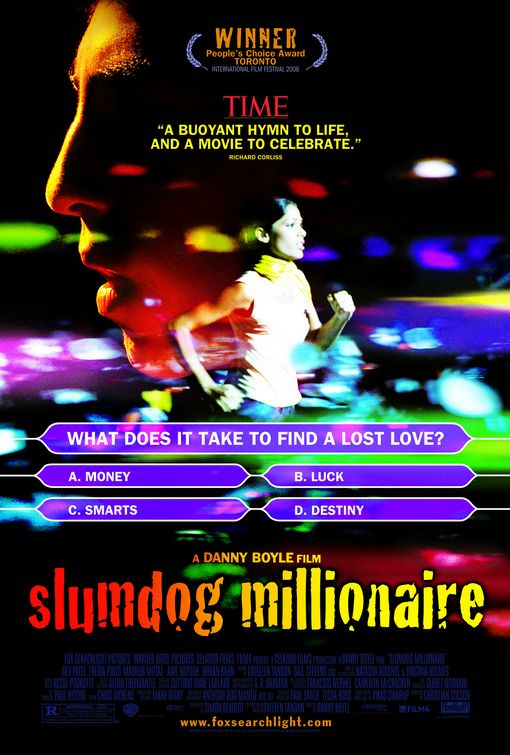
Comparison of Slumdog Millionarie & Somers town

Slumdog Millionaire
Cast:
Dev Patel: Jamal K MaliK

Fredia Pinto: Latika

This film is directed by Danny Boyle & Loveleen Tandan( co-director:India). Slumdog millionaire is a film about an Indian boy who grew up in the slums & becomes a contestant on the Indian Version of "Who wants to be a millionaire?" . He is arrested in suspicion of cheating while being interrogated. Events from his life history are shown which explains how he knows all the answers. Therefore, slumdog millionaire is not entirely seen as a British film as it set & filmed in India . Also, the film was an adaptation of a novel written by Vikas Swarup. Slumdog millionaire was distributed by Pathe Pictures international, Fox searched light pictures who teamed up with Warner Bros.

Somers Town
Somers town was distributed by 'Film Movement' & directed by Shane Meadows. This film was funded by EuroStar. This film is about 2 boys, both newcomers in London, forge an unlikely friendship over the course of summer. The boys are both infatuated with the same girl & pass their day bickering over which one of them she loves the most. A black & white study of a social environment in London.

Wednesday, September 16, 2009

New blog

I have created a new blog for our practical project for examiners & teachers to see how we have developed as a group. So, my new blog will have all my practical work & i'll use this blog to post my work that i have done at class or for homework.

Tuesday, September 15, 2009

Representing Contemoprary Britain

This article considers the ways in which British Cinema has represented the perspectives& experiences of those dwelling in contemporary Britain. This article has detailed information on sexuality, class, men, women & ethnicity.

Sexuality: Although sexual desires is a persistent theme in british cinema, it is usually dealt in a manner that is 'over flippant'.Whereas, other films that push the boundry of sexual frankness such as The Principles of Lust(2003) sexual desire is potrayed as fundamentally self- destructive or seen as wrong.

Class: A poll carried put by the Guardian newspaper in 2007 shows that 'ten years of Labour rule has apparently failed to create a classless society'. Films such as Atonement are constructed upon problematic relationahips between characters postioned differently on the social scale. Notingham Hill also positions its middle class characters with in an area of the capital economy commonly associate with ethnic & social diversity.

Men: British films are still dominated by narrative of male experience. but there has been non-masculine 'performance' as part of the stragery of improvement. Films such as The Full Monty, Billy Elliot show the impact of these types of films in society. Films such as Goodbye Charlie Bright(2001), The Football Factory & the buissness have proven to be more capable for giving the message about the contemporary pressure upon working class men than the films of other 'respectable' socially commited directors. In family films such as Harry Potter series, Strombreaker(2006) etc, young actors act as young heroes targetting audience in saving the world.

Women: Male dominated films far outnumber those told from the female perspective. Historic films such as Elizabeth & Charlotte Gray have been praised & celebrated for the role played by women.Recurring Scenarios of men dominated films have occassionally been answerd by 'female equivalents'. E.g the narrative of collective male endeavour is echoed by stories of self-empowerment in school for seduction, calender girls etc.Whereas, Beautiful creatures(2000)& High heels& low lives(2001) offer a glossily femanist spin on the buddy' movie, the ganster film & the caper movie. There has been an increse in the no of female directors entering the british film industry who could possible change the face of British films.

Ethnicity: British films have failed to represent all ethnic minorities. Its only after year 2000 that british films have focused on other ethnic minorities. in recent years,British Asian narrative films, characters have been most successful in british cinema such as Bend It Like Beckham, East is East etc.

Media, Pleasure & Identity

The Meaning of Meaningless
There is a theory on diasporic audience & studies which 'explores how dispersed global audiences use media to maintain connections with distant radical, ethnic, religion or national homelands'. Socialogical escapism refers to forensic use of media to dissect social importance.The writer says ' what it would feel like to live in a world where we could be whatever we wanted to be' to explain this terminology. On the other hand, psychological escapism refers to aspects of the personality largerly affceted by the social setting.The writer concludes that watching moreTV has a effect on the interset you have in what life means.
Healey& Ross's(2000) show exploration of older television viewers show how such audiences indeed 'use' media to articulate what it means to be vennerable.In conclusion, this article shows how people use media such as TV to escape from the 'real world'.